



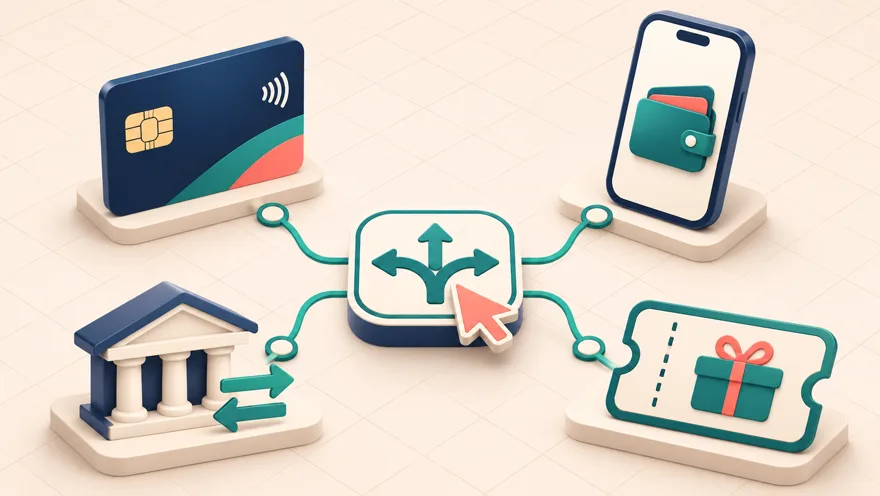
Start with the route, not the promise
The cashier is an account tool, not a market-wide standard. Two licensed businesses can label the same rail differently, set different minimums and use different fallback routes. The logged-in cashier and current payment terms are the final source for your account.
Separate four cost layers. The operator may state a fee; the payment provider may have a charge; a bank may apply its own terms; and a non-GBP route can add currency conversion. A page that says “no fee” without naming the layer is incomplete.
| Route | Deposit direction | Withdrawal direction | Main check |
|---|---|---|---|
| Visa/Mastercard debit | Common | Often, but issuer support varies | Card active, in your name, able to receive a credit |
| Bank transfer | Varies | Common fallback | Account name, sort code/account number, rail and reference |
| Pay by Bank / open banking | Common at some businesses | May return to the same account | Bank consent, ownership and provider support |
| Apple Pay / Google Pay | Tokenised card deposit at some businesses | May return to underlying card or a fallback | Identify the card behind the token |
| PayPal | Available at selected businesses | Often only after a PayPal deposit | Same wallet account and email/account details |
| Paysafecard | Often account-based deposit | Operator-specific; do not assume | Plan a verified fallback before depositing |

The Great Britain rules that shape the answer
Great Britain’s credit-card ban applies to online casino gambling and requires operators to stop credit-card funding through e-wallets too. A mobile wallet is therefore not a loophole: the underlying card must be an eligible debit source.
Before depositing, read both the deposit and withdrawal tables. If the method cannot receive money, note the nominated bank or card route, any ownership check and the document channel. That one minute prevents many first-withdrawal surprises.
This page applies to adults in England, Scotland and Wales using businesses licensed for Great Britain. It does not cover Northern Ireland or offshore sites aimed at British users without a UK Gambling Commission licence. Check the exact business and domain in the public register before relying on any process described here.
A practical check sequence
- Confirm the domain in the UKGC public register.
- Open the logged-in cashier and record the methods actually shown for your GB account.
- For each candidate, check deposit and withdrawal separately.
- Record minimum, maximum, operator fee, currency and stated processing window.
- Check whether the route must be in the same name as the gambling account.
- Choose a route whose withdrawal path you can verify before adding money.
Limits, fees and evidence
A method name alone does not prove a fee, minimum, maximum or speed. Those figures can change by operator, customer, currency and account status. Read the current logged-in cashier and terms. Record what was shown on the date of the transaction; do not copy an old comparison table into a complaint as if it were your contract.
Keep a redacted copy of the transaction ID, exact status, amount, time, method, masked destination, relevant terms and written replies. Store identity documents separately from ordinary screenshots. Send them only through the secure channel identified on the licensed domain.
Common mistakes
- A mobile wallet name does not prove the wallet itself receives the withdrawal; the credit may post to its underlying card.
- A prepaid method can be excellent for budgeting but awkward if the withdrawal requires a second verified route.
- “Instant bank transfer” may describe authorisation, not the operator review before release.
- Do not compare operator processing statements as if they were guaranteed personal arrival times.
Questions people ask
What is the safest payment method?
No method removes gambling risk. Use a GB-licensed business, an account in your name, GBP where possible, a preset limit and a route with clear withdrawal terms.
Are credit cards allowed?
No for online casino gambling in Great Britain. The ban also covers indirect e-wallet funding from a credit card.
Is a deposit method always a withdrawal method?
No. Check both directions in the live cashier and terms before depositing.
Continue through the casebook
- Debit card casino deposits and withdrawals in Great Britain
- Casino bank transfers: which clock are you waiting on?
- Pay by Bank and open banking at UK casinos
- Closed-loop casino withdrawals explained
Sources checked
- UK Gambling Commission — Preventing credit card use — checked 16 November 2026.
- UKGC — Payment methods and services condition — checked 16 November 2026.
- bet365 Help — Withdrawal methods (operator example) — checked 16 November 2026.
This is general editorial information, not legal or financial advice. Gambling can cause harm. If the task is no longer about a payment record but about stopping, use the responsible gambling help page.