


Confirmed detail and one unresolved conflict
| Property | Official page | Editorial treatment |
|---|---|---|
| Release | 1 February 2024 | Provider date |
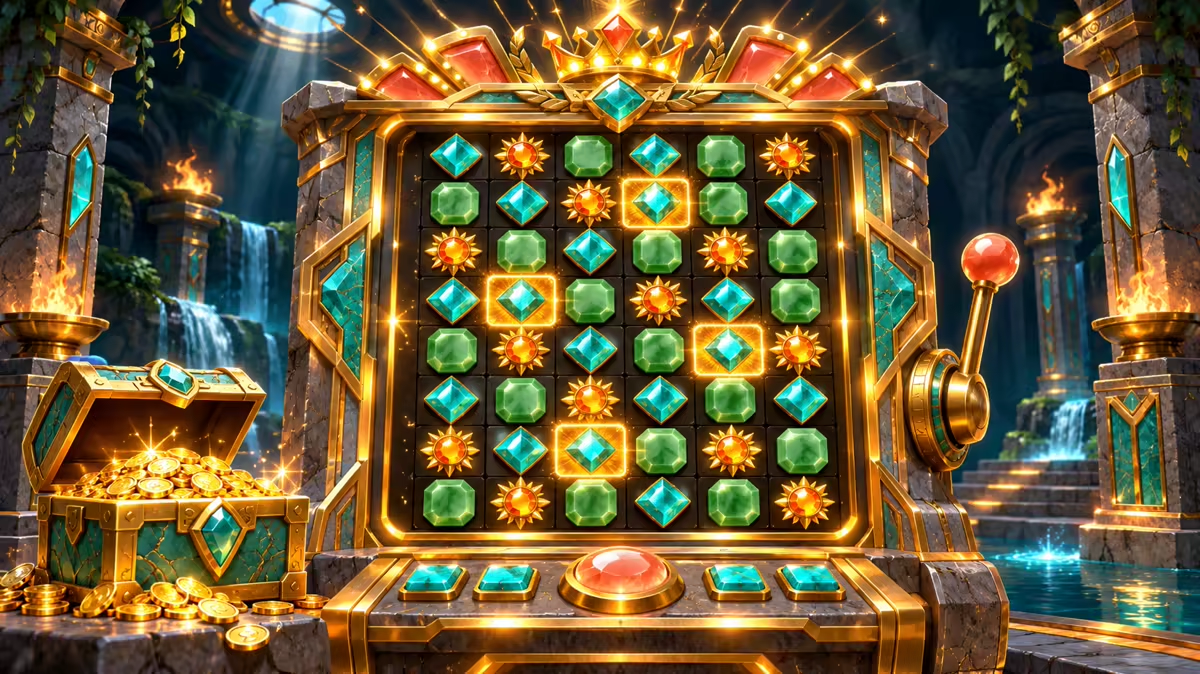
| Layout | 6×8 | Cluster-pays grid |
| Volatility | Very high | BGaming label |
| Maximum win | 10,000× stake | Maximum exposure only |
| Game ID | AztecClusters | Public provider identifier |
| RTP | Page shows both 99% and 97% | Omitted until provider conflict is resolved |
DEMO STATUS
No embedded demo was verified
The provider page offers play controls, but its public RTP labels conflict; no iframe is embedded here.

A cluster clears; the cell keeps history
Cluster pays begins with adjacent matching symbols. Once a qualifying group is evaluated and removed, the board can refill. Aztec Clusters adds persistence through cell multipliers: a location can become more important because of what happened there earlier in the sequence.
That persistence is not money stored for a later session. It belongs to the active game state defined by the rules. If the sequence ends or resets, the help file determines what carries forward and what disappears.
Sticky Wild and Dig-Up interaction
A sticky Wild provides substitution across repeated board states, while Dig-Up changes or uncovers parts of the grid. Together they can improve the chance that a refill makes another qualifying group, especially when developed multiplier cells are involved.
Free spins are triggered by three or more scatter symbols, with the provider describing awards from ten to twenty spins. The exact relationship between scatters, Wild persistence and multiplier retention should be read in the current rules because feature state can differ from the base game.
Example of a multiplier path
Imagine a group of teal shapes clears across six neighbouring cells. Those positions receive or increase their cell multipliers according to the rules. New symbols fall into the gaps. A later cluster overlaps three of the developed cells, so its evaluation can use the accumulated state. If the refill misses those positions, the visible multipliers do not create a win by themselves.
This example explains why location matters. It does not provide the probability of an overlapping cluster and does not resolve the provider's conflicting RTP labels.
Why no RTP appears in the headline table
BGaming's public page is internally inconsistent: its details area displays 99%, while explanatory copy and an FAQ label display 97%. Choosing either number would hide a primary-source conflict. The exact in-game help and provider clarification are required before publishing one value as definitive.
Very high volatility remains clear. A grid with developing multipliers can encourage “one more spin” thinking, but previous cells do not make a future paid result owed. Use a fixed spend and time limit, and never extend it to recover an unfinished board.
Frequently asked questions
How big is the Aztec Clusters grid?
BGaming describes a six-column by eight-row field, giving 48 visible cells.
What is the RTP?
The public provider page currently conflicts between 99% and 97%. This guide therefore omits RTP and directs readers to the exact game's help screen.
How many free spins can trigger?
The official page says three or more scatters can award between ten and twenty free spins.
Is the game available at a British casino?
No operator availability is asserted. This is a mechanics record; an independently chosen operator and its licensed domain must be checked separately.
Follow the cluster comparisons
- Fire Portals moves and merges Wild multipliers
- Esqueleto Explosivo 3 uses Avalanche refills
- Temple Tumble tracks cleared stone cells
- RTP: why the exact version matters
Provider source
- BGaming — Aztec Clusters — checked 16 November 2026.
The RTP discrepancy remains an open research item. No feature-buy or brand-availability statement is made for Great Britain.